Most technology executives are are challenged when they have to market themselves. I recall when 2019 hit, most were working from home and
leaders had to quickly shift to managing their tech teams via video conferencing.
Everything changed---in addition to
leading their teams to innovate and develop, now they had to become expert online coaches and motivational leaders.
Talk about
enacting "transformational on the job training"---they had to deliver quickly, regardless of their discomfort of "change"!
Today,
when there's more competition and company budgets are making room for AI developments by downsizing their employee count, adapting to the changed enviornment needs to be in your career strategy.
Technology leaders keep innovating and building, but they also have to advocate their unique career value through their communication and leadership skills in order to stand out in a career search.
Applying online is fruitless, and in networking conversations and interviews, your clear communication is what will spark interest in what you have to offer.
After 14 years of coaching tech leaders through career transitions, here's what I see separating the executives who land opportunities faster from those that resist tranformation in their career
communication.
#1, They take serious actions.
#2, They can answer these 4 questions with complete precision:
**1. What specific value do I create — in business terms, not technical terms? **2. What is the story of how I got here, and why does it matter for where I'm going?** **3. Who specifically needs what I uniquely offer right now? **4. What do I want them to do after every conversation?
Many executives are stuck and not sure what actions to take and
they struggle to answer question 2 clearly while the recipient is disinterested or lost in a sea of detail.
Almost none have practiced Question 2 out loud.
If you can answer all four with clarity and confidence, you're already in the top 5% of candidates — regardless of your credentials.
I know you have dozens of value stories buried in your career history.
But most executives never deliver them.
Remember that you may not be talking to someone who already understands what you do.
In fact, perhaps no one in the hiring decision chain truly understands what you do...
-The CFO doesn't know what a distributed systems architect does. -The CEO doesn't know what a principal engineer is. -Even the CTO at a different company may not understand your specific stack.
That's why your message of
how you add value needs to be
If you are ready
to take actions that attract the right opportunities, then let's have an introductory call. When we work together, the goal is to secure "job offers".
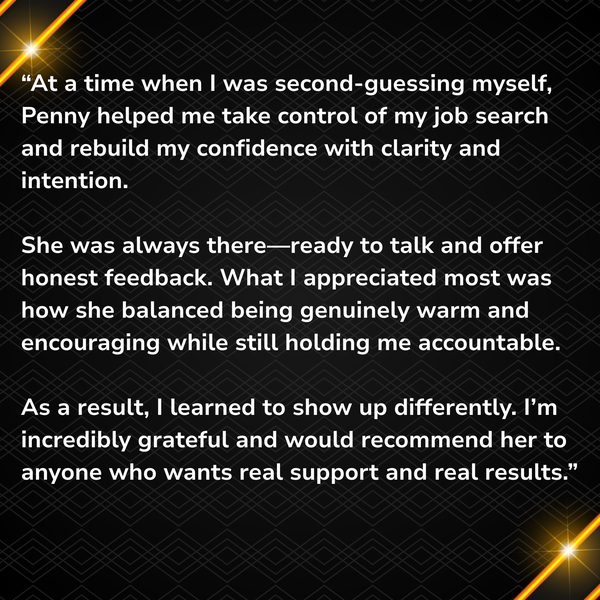
This is what happened for a recent client
(who had more than one offer)...
Here's your opportunity to learn how to navigate complex conversations and interviews that win the